

Login
MyFFonseca
If you do not have an account MyFFonseca, please register and get access to exclusive content to registered users!
Create registry
Login
MyFFonseca
If you do not have an account MyFFonseca, please register and get access to exclusive content to registered users!
Create registry


Proximity inductive sensor IMF - SICK
The economic standard for use in the food industry.
The IMF inductive proximity sensor is the new standard for reliability in the food industry. With its extended sensing ranges, made highly precise thanks to the use of SICK ASIC technology, the IMF ensures reliable, stable processes.
What's more, its wide-ranging specification limits allow the proximity inductive sensor IMF, from SICK, to be used in all areas of food production: a huge benefit when it comes to product selection and warehousing. The optical adjustment indicator saves time during commissioning and helps cut down on errors. Communication via IO-Link is also possible, creating more flexibility and adding more functions for automation applications. With an extensive standard product portfolio available, even special devices can be put into action quickly and easily.
The IMF inductive proximity sensor is the new standard for reliability in the food industry. With its extended sensing ranges, made highly precise thanks to the use of SICK ASIC technology, the IMF ensures reliable, stable processes.
What's more, its wide-ranging specification limits allow the proximity inductive sensor IMF, from SICK, to be used in all areas of food production: a huge benefit when it comes to product selection and warehousing. The optical adjustment indicator saves time during commissioning and helps cut down on errors. Communication via IO-Link is also possible, creating more flexibility and adding more functions for automation applications. With an extensive standard product portfolio available, even special devices can be put into action quickly and easily.

Proximity inductive sensor IMP - SICK
The inductive, high-pressure-resistant IMP sensors are perfectly suited for the query of end positions in hydraulic cylinders. The use of state-of-the-art ASIC and manufacturing technologies from SICK sets new standards in installation size, service life and load capability for the sensors.
Due to the stable stainless-steel housing and an active high-performance ceramic surface, they are pressure-resistant up to 500 bars. Above-average system throughput is a matter of course for the range of models M5, M8, M12 and M14 thanks to 1 million tested pressure cycles.
Due to the stable stainless-steel housing and an active high-performance ceramic surface, they are pressure-resistant up to 500 bars. Above-average system throughput is a matter of course for the range of models M5, M8, M12 and M14 thanks to 1 million tested pressure cycles.

Proximity inductive sensor IMR - SICK
The IMR inductive proximity sensors are not the least bothered by magnetic interference fields or weld spatter, such as arise in resistance welding applications. IMR sensors are made without a ferrite core, which makes them magnetic field resistant, and also have a very high electromagnetic compatibility.
Thanks to the rugged non-stick coating made from PTFE, these sensors provide very good protection against flying sparks and slag deposits, thereby guaranteeing a high operational safety. Since IMR sensors operate on the reduction factor 1 principle, they can detect all metals within the same sensing range. The very high sensing ranges of up to 75 mm help reduce mechanical damage to the sensors and therefore sensor failures, and increase plant availability.
Thanks to the rugged non-stick coating made from PTFE, these sensors provide very good protection against flying sparks and slag deposits, thereby guaranteeing a high operational safety. Since IMR sensors operate on the reduction factor 1 principle, they can detect all metals within the same sensing range. The very high sensing ranges of up to 75 mm help reduce mechanical damage to the sensors and therefore sensor failures, and increase plant availability.

Proximity inductive sensor SAM - SICK
The SAM proximity inductive sensor is the simple and intelligent way of speed monitoring with an additional IO-Link interface. SAM can be used as a classic speed monitor or innovative acceleration monitor with a revolutionary speed-independent monitoring function.
The proximity inductive sensor SAM, from SICK, checks if an adjustable speed or acceleration threshold is crossed and provides a switching signal. SAM is setting new standards and revolutionizing commissioning tasks and fields of application thanks to its fast response time, monitored range of up to 12,000 pulses per minute and intelligent start-up delay.
The proximity inductive sensor SAM, from SICK, checks if an adjustable speed or acceleration threshold is crossed and provides a switching signal. SAM is setting new standards and revolutionizing commissioning tasks and fields of application thanks to its fast response time, monitored range of up to 12,000 pulses per minute and intelligent start-up delay.

Reliable capacitive proximity sensors enclosed in a rectangular housing CQ - SICK
Capacitive proximity sensors can detect all types of material: powder-based, granulated, liquid, and solid – even through plastic walls.
SICK’s capacitive proximity sensors also feature high electromagnetic compatibility (EMC), which prevents incorrect switching.
CQ sensors, from SICK, feature rectangular housings that are suitable for all manner of installation conditions.
SICK’s capacitive proximity sensors also feature high electromagnetic compatibility (EMC), which prevents incorrect switching.
CQ sensors, from SICK, feature rectangular housings that are suitable for all manner of installation conditions.
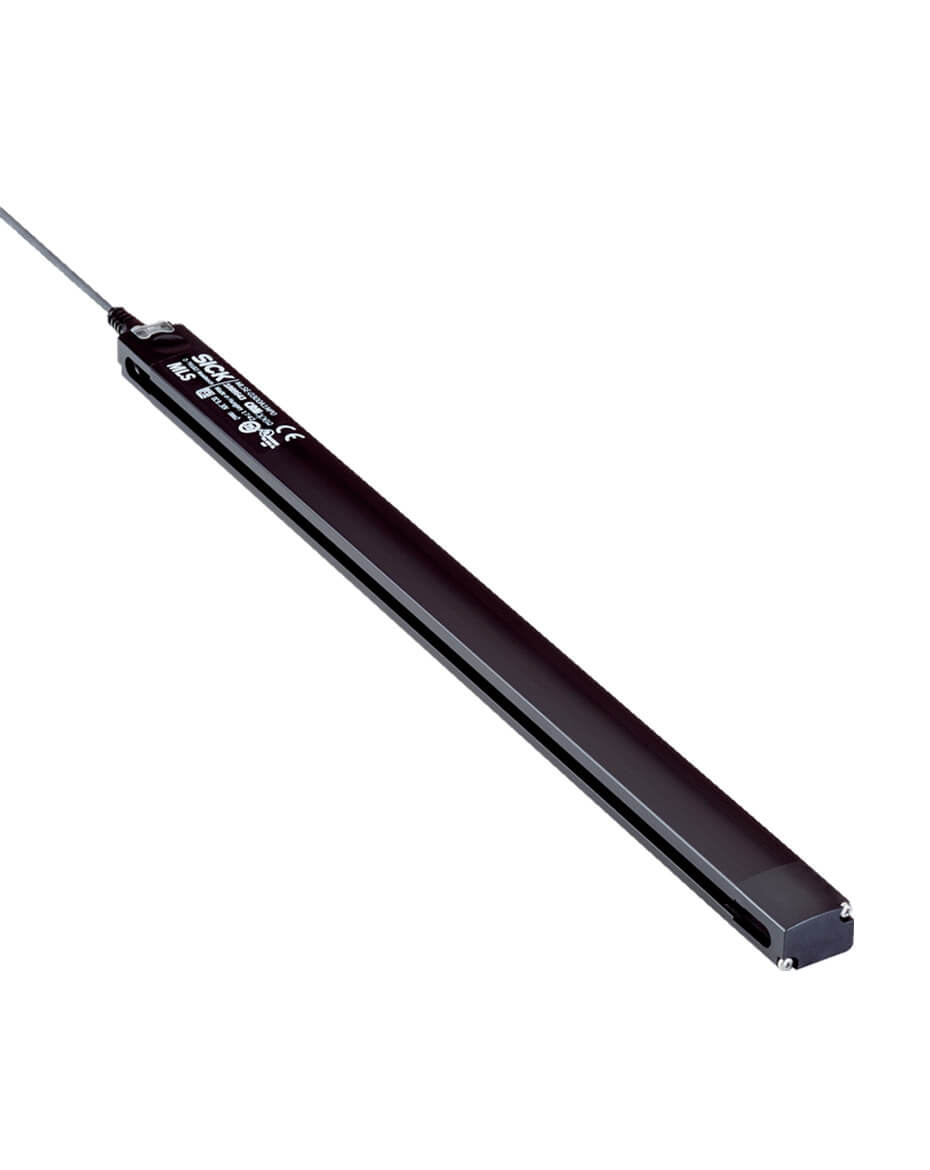
Sensor for magnetic line guidance MLS – SICK
The MLS is a magnetic line guidance sensor for navigating automated guided vehicles and carts. Navigation is done by aligning the sensor to the center of the magnetic line. Sensor positions are transmitted to the vehicle control via a CANopen interface.
The sensor reliably differentiates between up to three lines. The vehicle can therefore maneuver through branches and line junctions with no problem. When selecting the magnetic band and the installation height, the MLS allows for a lot of freedom and is available in various variants with different detection ranges. This enables high flexibility when it comes to design and retrofitting. Magnetic marks for additional vehicle commands can be attached to the side next to the line.
The sensor reliably differentiates between up to three lines. The vehicle can therefore maneuver through branches and line junctions with no problem. When selecting the magnetic band and the installation height, the MLS allows for a lot of freedom and is available in various variants with different detection ranges. This enables high flexibility when it comes to design and retrofitting. Magnetic marks for additional vehicle commands can be attached to the side next to the line.


Sale general conditions Garantias, reparações e devoluçõesPolítica de CookiesPrivacy PolicyReporting channel
F.Fonseca © All rights reserved.
- 0
- 1